What Percent of All Lower Court Cases Are Reviewed by Federal Appeals Courts

9b. The Structure of the Federal Courts
The judicial Power of the United States, shall be vested in i Supreme Court, and in such inferior Courts as the Congress may from time to time ordain and plant. -Article Iii, Section one, The Constitution of the United States
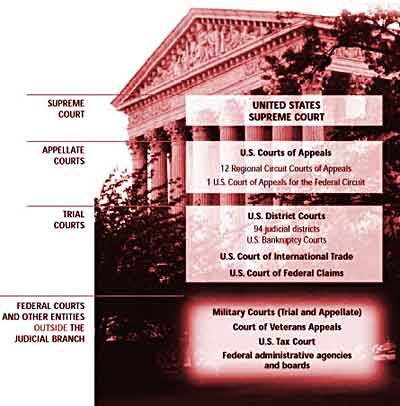
In the federal courtroom system the Supreme Court has terminal appellate jurisdiction over all courts in the United States.
Notice that, according to the Constitution, Congress creates courts.
By implication, Congress besides has the ability to reorganize and even dismantle the court system. This clause provides one of many examples of the checks and balances in the Constitution, but information technology likewise reveals the Founders' intent to grant greater powers to the legislative branch than to the judicial.
The fact that most of the basic court structure has inverse little since information technology was created past the Judiciary Human action of 1789 is an indication that Congress does not readily use this ability. The relative independence of the court system, likewise equally the evolutionary power of the judicial branch, has been generally respected past members of subsequent Congresses.
Ramble Courts
Courts established by the Judiciary Act of 1789 are chosen constitutional courts because they are mentioned in Commodity Iii (they are the "junior courts" in the quote in a higher place).
Judges who preside over these courts are nominated by the president, confirmed past the Senate, and serve lifetime terms every bit long as they showroom "proficient behavior." Over the years, Congress has created other courts to handle cases for special purposes.

The commencement Territorial Supreme Court was formed for the Dakota Territory in 1861, but didn't meet to hear appeals until 1867. This photograph shows the members of the courtroom meeting to conduct business for the beginning fourth dimension.
Legislative Courts
Those latter courts are referred to equally "legislative courts." For case, by the early 20th century, Congress had set up the U.S. territorial courts to hear federal cases in the territories that the United States began acquiring during the tardily 1800s. Judges for legislative courts are also appointed past the president and confirmed by the Senate, but they serve fixed, limited terms.
The Judicial Circuits
The Eighth Circuit includes the states of Arkansas, Iowa, Minnesota, Missouri, Nebraska, North Dakota, and Due south Dakota.
The federal court system is divided into 12 geographic circuits. For example, Circuit One includes the New England states of Maine, New Hampshire, and Massachusetts. Circuit Ix includes vii states in the far western part of the land. Originally, each state in each circuit was to have one district courtroom, where all federal cases from the land originated.
Over time, every bit the population grew, additional commune courts were added. Today, a total of 94 district courts be; they are staffed by more 600 judges. Some circuits have more others, based on population, just each circuit still has merely ane court of appeals. Cases not settled in the courts of entreatment may be appealed further, just only to the Supreme Courtroom.
Commune Courts and Courts of Appeals

Each U.S. district courtroom has a different seal, a different jurisdiction, and dissimilar local rules.
Most cases that deal with federal questions or offenses begin in district courts, which are almost always granted original jurisdiction. District courts hear appeals cases only in the rare instance of a ramble question that may arise in state courts. About lxxx per centum of all federal cases are heard in district courts, and most of them stop there. The number of judges assigned to district courts varies from two to 20-viii, depending on caseloads and population.

Courts of Appeal
Past the tardily 19th century, so many people were appealing their cases to the Supreme Court that Congress created another type of constitutional court, the courts of appeals. Today, along with 12 courts of appeals (1 for each excursion), a thirteenth courtroom, the Court of Appeals for the Federal Circuit, hears cases that deal with patents, contracts, and financial claims against the federal government.

The Ninth Circuit Courtroom of Appeals, located in San Fransisco, is noted not merely for its legal importance just its ornate architecture.
Courts of appeals never hear cases on original jurisdiction, and almost appeals come from district courts within their circuits. They do sometimes hear cases from decisions of federal regulatory agencies as well.
Appeals courts have no juries, and panels of judges (usually iii) decide the cases. Their decisions are virtually e'er final. Their decisions may be appealed only to the Supreme Court, and because the Courtroom is able to hear merely a very pocket-sized percentage of them, most no cases go further than the appeals courts.
Thus, even though the Founders surely intended that Congress hold a great deal of power over the judicial branch, in reality the basic organization of federal courts has remained basically the same throughout U.Due south. history. Congress has created new courts and reorganized others, and the organization has grown increasingly complex. The courts have a neat deal of independence, even so, and they accept established the judicial branch as a stiff coequal to Congress and the president.
Source: https://www.ushistory.org/gov/9b.asp

Post a Comment for "What Percent of All Lower Court Cases Are Reviewed by Federal Appeals Courts"